If you’re weighing up window canopy options for your Melbourne home, the most important decision you’ll make isn’t colour or style — it’s material. Melbourne’s climate is genuinely punishing: UV index readings of 11–12 in summer, 40°C-plus days across the northern and western suburbs, sudden southerly busters that drop temperatures 15 degrees in an hour, and humidity patterns that shift dramatically between the coastal Mornington and Bellarine areas and the drier inland LGAs of Melton, Whittlesea, and Yarra Ranges. A window canopy that performs in all of that is a smart, long-term investment. One that doesn’t — and plenty on the market won’t — becomes a fading, cracking liability within a few years.
This guide cuts through the noise on materials, UV degradation, heat resistance, maintenance, and Melbourne-specific performance data so you can make a confident, informed decision. Whether you’re looking at a Dutch hood awning for a heritage entryway, a door canopy for an alfresco, or a run of window awnings across a north-facing facade — the material framework stays the same.
What Is a Window Canopy and Why Melbourne Homes Need One
A window canopy is a fixed or semi-fixed overhead shade structure mounted directly above a window or doorway. Unlike a full patio awning, which projects several metres to cover an outdoor entertaining area, a window canopy is purpose-built for the aperture itself — intercepting direct sunlight and rain before it reaches your glazing, frames, and interior.
For Melbourne homeowners, this matters enormously. Glass is one of the least effective barriers to solar heat gain: a standard single-glazed pane transmits up to 87% of solar radiation directly into your home. A well-positioned window canopy stops that heat before it reaches the glass, reducing interior temperatures without relying on air conditioning. Research from the Australian Department of Climate Change, Energy, the Environment and Water confirms that external shading is among the highest-impact passive cooling measures for Australian homes, capable of cutting cooling energy consumption by 15–25% in appropriate climates.
Beyond thermal comfort, a window canopy protects your window frames, furnishings, and flooring from UV bleaching, reduces glare, keeps doorways and entry thresholds dry during Melbourne’s unpredictable rain events, and — when correctly specified — adds genuine architectural character to your home’s exterior.
Acrylic vs Polyester vs HDPE: Which Material Wins in Melbourne Heat?
This is the single most-asked question when Melbourne homeowners start researching awning fabrics, and the answer isn’t uniform — it depends on orientation, application, and what you’re prioritising. Here’s an honest, technical breakdown.
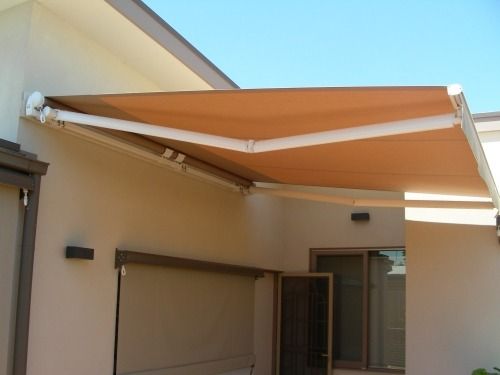
Solution-Dyed Acrylic — The Gold Standard
Solution-dyed acrylic fabrics — produced by brands including Sunbrella (Glen Raven), Docril (Ferrari Group), and Recasens — are the benchmark for outdoor awning performance in Australia. The key distinction from standard woven fabric is that the colour is locked into the acrylic fibre during the extrusion process, before weaving. There is no surface dye layer to fade or peel. When UV radiation hits solution-dyed acrylic, it’s attacking the coloured fibre itself, not a topcoat — and acrylic is inherently UV-stable as a polymer.
In practical terms for Melbourne: solution-dyed acrylic maintains its colour and structural integrity for 10–15+ years in full-sun north and west-facing positions. Leading manufacturers back this with 5–10 year fade warranties tested against international standards including ISO 105-B02 (xenon arc fade testing) and AS/NZS 4399 (sun protection ratings for UV-blocking textiles). The open-weave construction also allows heat to dissipate rather than trap it, maintaining a breathable canopy that doesn’t act as a heat sink.
PVC-Coated Polyester — Budget-Friendly but Climate-Compromised
PVC-coated polyester is the material you’ll find in most budget window canopies, pop-up market stalls, and imported products. It’s cheaper to produce, highly waterproof due to the PVC laminate, and comes in a wide range of colours. For an application that doesn’t receive sustained UV exposure — a south-facing window, a deeply recessed entry, or a commercial application where the canopy will be replaced regularly — it can be a reasonable choice.
The problem in Melbourne is prolonged, high-intensity UV exposure. PVC, unlike acrylic, is UV-unstable and will yellow, crack, and embrittle over time when exposed to UV index 10+ conditions. The PVC laminate can also delaminate from the polyester base, especially where the fabric flexes at seams and around frame fixings. In a full-sun Melbourne summer, this degradation typically becomes visible within 3–5 years and structurally significant by year 6–8. The surface dye (not solution-dyed) fades comparatively quickly — often noticeably within 2–3 years in harsh exposures.
HDPE Shade Cloth — Breathability and Heat Management
High-density polyethylene (HDPE) shade cloth is a knitted mesh fabric engineered specifically for UV and thermal management. Unlike woven acrylic or polyester, HDPE shade cloth is designed to be permeable — allowing air movement while blocking a defined proportion of UV radiation (typically 50–95% depending on the knit density).
For window canopies where ventilation matters as much as shade — particularly north-facing kitchen or living room windows in Melbourne’s western suburbs, where summer ambient temperatures regularly exceed 38°C — a 70–80% HDPE shade cloth can reduce radiant heat load on glazing without creating a sealed heat trap above the window. Quality HDPE shade cloth (from manufacturers such as Polyfab or Gale Pacific’s Coolaroo range) is UV-stabilised with a typical performance warranty of 10 years. It won’t waterproof the way acrylic or PVC does, but it excels at the heat management task.
Summary Comparison
| Feature | Solution-Dyed Acrylic | PVC-Coated Polyester | HDPE Shade Cloth |
|---|---|---|---|
| UV Resistance | Excellent — colour in fibre, 10+ yr warranty | Moderate — surface dye degrades within 3–5 yrs | Excellent — UV-stabilised polymer, 10 yr warranty |
| Fade Resistance | Very high — tested to ISO 105-B02 | Low-moderate — surface colour fades under UV | High — pigment UV-stabilised in extrusion |
| Waterproofing | Good — water-repellent; not fully waterproof | Excellent — laminated PVC fully waterproof | None — permeable mesh |
| Breathability | Good — open weave allows airflow | Poor — sealed surface traps heat | Excellent — engineered for airflow |
| Mould Resistance | High — acrylic resists mould growth | Moderate — PVC surface can trap organic matter | High — open knit doesn’t retain moisture |
| Expected Lifespan (Melbourne) | 15–20 years with maintenance | 5–8 years full sun; up to 12 yrs sheltered | 10–15 years with maintenance |
| Typical Fabric Warranty | 5–10 years | 1–3 years | 10 years |
| Best Melbourne Application | All orientations — especially N and W facing | S-facing, sheltered, or temporary installations | N and W-facing heat management; alfresco shade |
| Cost Position | Premium | Budget to mid-range | Mid-range |
How UV Exposure Degrades Awning Fabrics Over Time
Understanding the mechanism of UV degradation helps explain why material specification matters so much in an Australian context. Melbourne sits at approximately 37–38 degrees south latitude, which already places it in a zone of elevated UV relative to comparable latitudes in the Northern Hemisphere. Melbourne’s UV exposure is further intensified by Australia’s thinner ozone layer (particularly relevant over southern latitudes), low atmospheric particulate matter (relative to polluted Northern Hemisphere cities), and the angular geometry of afternoon westerly sun in summer — hitting facades at the highest thermal impact angle.
The Degradation Process
UV-B radiation (wavelengths 280–315nm) is the primary driver of polymer degradation in awning fabrics. It breaks covalent bonds in polymer chains — a process called photodegradation — causing oxidation, chain scission, and cross-linking that manifests as discolouration, brittleness, reduced tensile strength, and surface cracking. In surface-dyed polyester, UV-B also breaks down the chromophores (colour molecules) in the surface coating, causing fading that isn’t merely aesthetic — it signals underlying structural degradation.
UV-A radiation (315–400nm), while less energetic than UV-B, contributes to cumulative thermal-photodegradation over time, particularly where fabrics experience repeated heat cycling — expanding in summer heat and contracting overnight or during Melbourne’s rapid cool-changes.
How Different Materials Respond
- Solution-dyed acrylic: Acrylic (polyacrylonitrile) is among the most inherently UV-stable synthetic polymers. UV inhibitors are incorporated during fibre production, not added as a topcoat. Long-term xenon arc testing (simulating years of UV exposure per ISO 105-B02) shows solution-dyed acrylic retaining over 80% of original colour strength after equivalent multi-year Melbourne exposure cycles.
- PVC-coated polyester: PVC contains UV-absorbing additives, but these are consumable — they deplete over time. Once depleted, UV attacks the PVC polymer chain directly, causing yellowing and embrittlement. The underlying polyester substrate is also susceptible to UV-B degradation once the PVC layer is compromised.
- HDPE shade cloth: HDPE is UV-stabilised through hindered amine light stabiliser (HALS) additives during extrusion. HALS technology is a catalytic process — HALS molecules regenerate during the degradation cycle rather than being consumed — giving HDPE shade cloth excellent longevity relative to its cost.
Temperature, Humidity, and Material Performance in Melbourne’s Climate

Melbourne’s climate is officially temperate oceanic (Köppen Cfb), but it behaves with the unpredictability of a semi-arid climate when the north-westerlies arrive in November–March. The Bureau of Meteorology’s long-term data for Melbourne shows average maximum temperatures of 25.7°C in summer, but this understates the intensity of individual heat events — Melbourne regularly records 5–10 consecutive days above 35°C and single-day peaks above 43°C, particularly in the City of Wyndham, Melton, Brimbank, and Hume LGAs in the city’s north-west.
What this means materially: awning fabrics installed on Melbourne homes face thermal cycling across an extreme range. A canopy surface temperature in full January sun can reach 55–70°C. The same surface on a July evening may be near 4–6°C. This 50–65°C daily range — repeated across Melbourne’s swing seasons — causes thermal expansion and contraction stress on fabrics, stitching, frame joints, and fixings that budget-grade products simply aren’t engineered to absorb over multiple years.
Melbourne Suburb-Level Climate Variation
Melbourne’s climate isn’t uniform, and material specification should reflect local conditions:
- Inner-east suburbs (Hawthorn, Camberwell, Kew, Malvern): Moderate coastal influence, lower extremes than the west. Acrylic fabrics perform excellently. Aesthetics matter highly in these heritage-dense areas — colour and heritage-appropriate fabric patterns are as important as performance.
- North-west corridor (Melton, Wyndham, Brimbank, Hume): Melbourne’s hottest belt. UV exposure is highest, heat events most prolonged, and soil movement (reactive clays) can affect masonry fixings over time. Solution-dyed acrylic with heavy-duty powder-coated aluminium frames is the right specification here.
- Inner-south and Bayside (Brighton, St Kilda, Port Melbourne, Frankston): Coastal salt air adds corrosion risk to frame materials. Powder-coated aluminium over galvanised steel. Acrylic fabrics with marine-grade stitching are recommended within 3–5km of Port Phillip Bay.
- Dandenong Ranges fringe (Croydon, Ringwood, Knox, Yarra Ranges): Higher rainfall, humidity spikes, leaf litter. Mould resistance is the priority alongside UV protection. Acrylic with mould-inhibiting treatments, combined with a maintenance schedule geared to seasonal leaf fall, is most appropriate.
- Mornington Peninsula (Frankston, Mornington, Rosebud): Combines coastal salt risk with high summer UV and tourist-season humidity. Solution-dyed acrylic with marine-grade frame specification and regular fabric rinse maintenance.
Humidity, Mould, and Moisture Resistance
Melbourne’s relative humidity averages 57–65% annually but climbs significantly in the eastern suburbs and the peninsula during autumn — precisely when leaf fall creates organic debris that rests on canopy fabrics. Organic matter plus moisture plus shade (the underside of a window canopy is a perfect microclimate for mould) creates ideal conditions for Cladosporium and Aspergillus mould species that will stain and eventually degrade fabric if left unchecked.
Solution-dyed acrylic resists mould colonisation better than polyester because it doesn’t retain moisture in the fibre structure — acrylic is hydrophobic at the polymer level. However, no outdoor fabric is fully mould-proof under sustained damp conditions. Regular maintenance is the practical answer (covered in detail in the maintenance section below). HDPE shade cloth’s open-knit structure also prevents moisture retention, making it naturally resistant to mould without needing topical treatments.
How Colour and Weave Affect Heat Absorption and Fading
Colour choice for a window canopy isn’t purely aesthetic — it directly affects both thermal performance and long-term appearance under Melbourne’s UV load.
Colour and Solar Heat Gain
Darker colours absorb more solar radiation and convert it to heat at the fabric surface. A charcoal or dark green canopy will reach higher surface temperatures than a cream or light tan canopy under identical conditions. However, the more relevant metric for interior comfort isn’t the fabric’s surface temperature — it’s how much solar radiation is transmitted through the canopy to the window below.
For opaque or densely woven fabrics (acrylic or polyester), a lighter colour reflects more of the incident solar radiation back skyward rather than absorbing and re-radiating it downward. This makes lighter colours technically superior for reducing heat load on the window beneath. In practice, light neutrals — cream, sandstone, light grey — are the most thermally efficient colours for Melbourne’s north-facing window canopies.
That said, lighter colours also reveal dirt, bird droppings, and green algae staining more visibly than mid-tones. The practical sweet spot for most Melbourne homeowners tends to be mid-toned neutrals: warm greys, stone, heritage green, earthy tans — colours that balance thermal performance with low-maintenance appearance.
Weave Density and Openness Factor
Woven acrylic fabrics are available in varying degrees of openness. A tighter weave provides better waterproofing but can trap heat beneath the canopy in still conditions. An open weave (higher air permeability) allows convective cooling — warm air escapes upward through the fabric rather than building up as a heat layer against your window. For Melbourne’s often-still summer mornings before the sea breeze arrives, an open-weave acrylic is noticeably cooler beneath than a tightly woven one.
Fabric standards including AS/NZS 4399 measure Ultraviolet Protection Factor (UPF) for textiles — a UPF 50+ rating blocks at least 98% of UV radiation. Most quality awning fabrics from reputable manufacturers achieve UPF 50+ regardless of weave density, but verifying this specification from your supplier before purchase is worthwhile for Melbourne’s extreme UV conditions.
Australian Standards and Technical Performance Benchmarks
Material recommendations for window canopies installed in Australia should be anchored in applicable Australian and international standards. The key benchmarks relevant to fabric performance and installation are:
| Standard | What It Covers | Relevance to Window Canopies |
|---|---|---|
| AS/NZS 4399:1996 | Sun protective clothing — evaluation and classification (UPF) | Provides UPF rating methodology applicable to awning fabrics; UPF 50+ is the target for materials used in UV-exposed positions |
| AS/NZS 1170.2 | Structural design actions — Wind actions | Sets wind load requirements relevant to fixed canopy frame engineering; governs structural fixings and spans for Melbourne wind zones |
| ISO 105-B02 | Colour fastness to artificial light — Xenon arc fading lamp test | The primary international benchmark for awning fabric fade resistance; solution-dyed acrylic typically achieves ISO 105-B02 rating 7–8 (very high to excellent) |
| EN 13561:2015 | External blinds and awnings — Performance requirements including wind resistance, operating force, and mechanical endurance | European standard widely referenced by Australian manufacturers for operational performance; relevant to retractable and folding arm canopy systems |
| AS 3600 | Concrete structures — relevant to masonry wall fixing performance | Affects bracket fixing specifications in brick and rendered walls; critical for correct installation in Melbourne’s reactive clay zones |
| Victorian Building Regulations 2018 | Structural building work permits in Victoria | Governs when a building permit is required for canopy installation; varies by structure size, wall attachment method, and heritage status |
When sourcing a window canopy for your Melbourne home, ask your supplier which standards their specified fabric and frame system is tested against. A reputable supplier — like Melbourne Awnings — will be able to provide manufacturer technical data sheets with specific performance ratings rather than vague marketing language.
Maintenance and Care to Maximise Material Lifespan
Even the best-specified window canopy will underperform its theoretical lifespan without regular, appropriate maintenance. In Melbourne’s climate, the specific threats are UV-accelerated degradation, organic debris accumulation in autumn, salt air corrosion (Bayside and coastal properties), and mould from autumn-winter humidity. Here’s a practical, seasonally-aware maintenance programme.
Routine Fabric Care — Year-Round
- Monthly visual inspection: Check for bird droppings, leaf build-up, any stitching separation at seams or frame attachment points. Address these immediately — organic matter left on acrylic will cause staining and eventually mould colonisation even on acrylic’s mould-resistant surface.
- Hose rinse 3–4 times per year: A simple garden hose at moderate pressure removes dust, pollen, and loose debris before they bond to the fabric surface. Do this before Melbourne’s October–November pollen season peak, at the end of summer, after winter, and after any major storm event.
- Brush debris from fixed canopies after autumn leaf fall: Melbourne’s cool, still autumn days allow leaves and organic matter to accumulate on fixed window canopies — particularly in the eastern suburbs where plane trees and elms dominate. A soft brush (not stiff bristles) removes debris without abrading the fabric surface.
Deep Cleaning — Twice Yearly
- Acrylic fabrics: Mix mild dish soap (pH-neutral, no bleach) in lukewarm water. Apply with a soft-bristle brush in gentle circular motions. Rinse thoroughly with fresh water and allow to dry completely before any prolonged wet weather. For Sunbrella or Docril fabrics specifically, manufacturers recommend avoiding harsh solvents, petroleum-based cleaners, or abrasive scrubbing pads — these compromise the fabric’s water-repellent finish.
- Mould treatment on acrylic: Mix one cup of white vinegar per four litres of warm water. Apply with a soft brush to affected areas, allow to dwell for 10–15 minutes, then rinse thoroughly. Do not use sodium hypochlorite (bleach) on solution-dyed acrylic — bleach degrades the acrylic UV inhibitors and causes premature embrittlement even if it removes the immediate mould stain. Repeat if necessary — vinegar is safe for multiple applications.
- HDPE shade cloth: Rinse with a hose and mild detergent if required. HDPE’s open knit doesn’t trap debris like woven fabrics; it requires less intensive cleaning. A thorough rinse is usually sufficient.
- PVC-coated polyester (if fitted): Wash with mild soap and water. Avoid high-pressure washers, which can delaminate the PVC coating at seams. Apply a UV-protective vinyl conditioner annually to slow surface degradation — this extends the cosmetic appearance but doesn’t replace the underlying UV stabilisation that solution-dyed materials have intrinsically.
Frame and Fixing Care
- Annual fixing inspection: Particularly important post-Melbourne storm season (typically August–September, when strong westerlies and spring squalls peak). Check wall brackets for corrosion at the fixing point, tighten any loosened bolts, and inspect the wall substrate for any crack propagation around fixings — an early indicator of reactive clay soil movement.
- Powder-coated aluminium frames: Wipe down with a damp cloth annually. Within 5km of Port Phillip Bay, increase to twice yearly — salt air deposits accelerate powder-coat degradation at any scratches or chips. Touch up scratches with matching powder-coat pen (available from your installer) to prevent corrosion starting at damaged spots.
- Galvanised steel frames: Inspect for rust at welded joints and cut edges. Apply a zinc-rich cold galvanising spray to any rust spots immediately — left unchecked, steel rust can migrate through fixings into the wall substrate. Wipe down regularly in coastal Melbourne locations.
Seasonal Tips for Melbourne’s Climate
Melbourne Maintenance Calendar
- October (pre-summer prep): Deep clean fabric, inspect fixings, check for any winter mould. Lubricate retractable mechanism if applicable.
- January–February (peak summer): Monitor for UV fading on sun-exposed surfaces. After any 40°C+ day, check that fabric hasn’t shifted on the frame under thermal expansion.
- April (post-summer / autumn): Clear leaf fall, deep clean, and re-check stitching after the thermal stress of summer. Apply protective treatment to steel frames.
- August–September (post-storm season): Full structural inspection — fixings, brackets, wall substrate integrity. Address any corrosion before the next warm season.
How Long Will My Window Canopy Last?
With quality materials and this maintenance programme, realistic Melbourne lifespans are:
Solution-dyed acrylic with powder-coated aluminium frame: 15–20 years before fabric replacement is typically needed. Frame often outlasts multiple fabric replacements.
HDPE shade cloth with powder-coated aluminium frame: 10–15 years fabric lifespan. Lower initial investment with solid longevity.
PVC-coated polyester with powder-coated steel frame: 5–8 years in full-sun north/west-facing Melbourne positions before fading and embrittlement require fabric replacement.
The cost-to-longevity equation strongly favours premium acrylic — the upfront differential is recovered well within the first replacement cycle of a budget fabric.
Material Differences Between Fixed, Retractable, and Motorised Canopies
Material requirements vary meaningfully between fixed window canopies, retractable systems, and motorised motorised awning solutions — not just in performance specification but in the physical stresses the fabric must absorb.
Fixed Window Canopies
Fixed canopies — including Dutch hood awnings, flat door canopies, and fixed barrel canopies — hold the fabric under constant tension, year-round, in a single position. The fabric never needs to roll or fold, meaning pliability and crease-resistance are less critical than they are for retractable systems. Heavier woven acrylics and even HDPE can be used without concern for fatigue cracking at fold points. The primary fabric stresses are UV exposure, thermal cycling, and precipitation impact load.
Retractable and Folding Arm Awnings
Folding arm awnings and retractable canopies subject their fabrics to repeated rolling and unrolling cycles — potentially thousands of times over a decade. This requires a fabric with excellent flex fatigue resistance, tight and uniform weave to resist tracking under the roller bar, and consistent tensile strength across the full width. Solution-dyed acrylic specifically formulated for retractable systems (with tighter weave specifications than fixed-application fabrics) is the industry standard. Manufacturers like Dickson, Recasens, and Tempotest produce retractable-specific acrylic ranges tested for 10,000+ operation cycles.
Fabrics for retractable systems should also have enhanced water-repellency — when a retractable canopy is rolled away wet (as happens frequently in Melbourne’s variable weather), the fabric must dry out thoroughly within the rolled housing to prevent mould developing in the dark, damp environment. Hydrophobic acrylic dries much more effectively than PVC-coated materials in this situation.
Motorised Systems
Motorised awnings and retractable roof systems often incorporate wind sensors that automatically retract the canopy when wind speed exceeds a set threshold — an important feature for Melbourne, where 60–80 km/h northerly gusts are not unusual in spring. For motorised systems, fabric weight is a consideration alongside performance: a heavier woven fabric creates more torque demand on the motor, affecting motor longevity. Mid-weight solution-dyed acrylic (typically 250–320 g/m²) is the optimal balance of performance and motor load for Melbourne-scale motorised window canopy systems.
Heritage Overlays and Strata Regulations Affecting Material Choices in Melbourne
Melbourne has one of the most extensive networks of heritage overlays in Australia, encompassing significant portions of the inner suburbs — Carlton, Fitzroy, Collingwood, Richmond, Hawthorn, Malvern, St Kilda, South Melbourne, and many others. If your property is within a heritage overlay, material selection for a window canopy is not solely a performance decision — it’s also a planning compliance consideration.
Heritage Overlay Properties
Planning permit requirements for heritage overlay properties typically require that external alterations be sympathetic to the heritage character of the property and precinct. For Victorian-era, Edwardian, and Federation-period homes — the dominant heritage types in Melbourne’s inner suburbs — this usually means:
- Traditional fabric patterns (striped canvas in heritage colour combinations — navy/cream, burgundy/cream, forest green/cream) or plain canvas in period-appropriate tones
- Curved or barrel canopy profiles (Dutch hood style) rather than flat or angular contemporary profiles
- Wrought-iron or cast-iron heritage bracket details where the design aesthetic demands it
- Powder-coat colours that match or complement existing heritage window frames (typically heritage green, charcoal, or black rather than contemporary grey or white)
The good news is that solution-dyed acrylic is available in a very wide range of heritage-appropriate colourways from manufacturers including Sunbrella and Docril. A knowledgeable Melbourne awning supplier will have heritage-specific fabric sample books and can cross-reference colours with your council’s heritage advisory guidelines. Melbourne Awnings supplies and installs heritage-appropriate window canopies across Melbourne’s inner suburbs — our team navigates this process regularly and can assist with supplier documentation for planning permit applications.
Body Corporate and Strata Properties
For apartments and townhouses managed under an owners corporation (body corporate), any external installation including a window canopy will almost certainly require owners corporation approval under the OC rules. Approval requirements typically include a product specification sheet, colour samples, and confirmation that the proposed canopy matches or is compatible with existing installations in the building.
Specifying a window canopy with a specific fabric and powder-coat colour from an established manufacturer makes the approval process significantly smoother — you’re providing professional documentation rather than photos from an online marketplace. Melbourne Awnings can prepare a full specification package for owners corporation submissions on request.
Choosing the Right Material for Your Melbourne Home
Pulling all of the above together into a practical framework: here’s how to approach material selection for a Melbourne window canopy based on your specific situation.
Material Selection Decision Framework
- North or west-facing window, full sun, maximum UV exposure: Solution-dyed acrylic (Sunbrella, Docril, or equivalent). Powder-coated aluminium frame. UPF 50+ rated fabric.
- East or south-facing window, partial sun, waterproofing priority: Solution-dyed acrylic or quality PVC-coated polyester. Either frame material. Tighter weave for waterproofing over breathability.
- Heat management priority, ventilation important (e.g. north-facing kitchen): HDPE shade cloth (70–80% block factor). Open-weave or mesh canopy profile. Powder-coated aluminium frame.
- Heritage overlay property, inner-east suburb: Solution-dyed acrylic in heritage colourway or stripe pattern. Dutch hood or barrel profile. Heritage-appropriate bracket and frame specification.
- Coastal or Bayside property (within 5km Port Phillip Bay): Solution-dyed acrylic with marine-grade stitching. Marine-grade or powder-coated aluminium frame — avoid galvanised steel unless with heavy-duty corrosion protection.
- Retractable or motorised system: Retractable-specification solution-dyed acrylic (tight weave, flex-tested). Wind sensor integration for Melbourne spring conditions.
- Budget-conscious but quality-focused: HDPE shade cloth with powder-coated aluminium frame represents excellent value — better UV longevity than budget polyester at a lower initial investment than premium acrylic.
Frequently Asked Questions
Real questions from Melbourne homeowners — answered directly.
Ready to Choose the Right Window Canopy for Your Melbourne Home?
Melbourne Awnings has been designing, supplying, and installing quality window canopies, Dutch hood awnings, door canopies, and folding arm awnings across Melbourne for over 35 years. Our team will assess your home’s orientation, wall substrate, and aesthetic requirements — and recommend the exact material, frame, and profile that will perform for Melbourne’s climate over the long term.
No guesswork. No pushy sales. Just straightforward, expert advice from people who know this city’s climate inside out.