If you have been wondering whether balcony awnings in Melbourne need council or strata approval before installation, you are not alone. Across Melbourne’s growing apartment market, thousands of residents are transforming underutilised outdoor spaces into liveable, sun-protected retreats. Yet the question of approval stops many people before they even get a quote. The answer, as with most things in Melbourne’s diverse built environment, depends on where you live, what you plan to install, and how your building is managed. This guide cuts through the confusion and covers everything from strata rules to wind ratings, privacy options, and what different awning styles actually cost in 2026.
Moreover, Melbourne’s four-seasons-in-one-day climate makes outdoor shade solutions particularly worthwhile. Summers bring fierce UV exposure. Afternoons deliver unpredictable winds. Additionally, the city’s housing mix ranges from sprawling suburban homes to high-rise CBD apartments — and each setting demands a different approach to balcony shade. Therefore, understanding your options before you commit saves both time and money.
Do You Actually Need Approval for a Balcony Awning?
This is the first question most Melbourne homeowners ask. Fortunately, the answer is relatively straightforward once you understand the two main approval pathways: council permits and strata body corporate consent.
Council Permits in Melbourne
For standalone homes and townhouses in Melbourne, most standard awning installations do not require a planning permit. Under Victoria’s Victorian Planning Provisions, many residential shade structures qualify as exempt development, particularly when they meet setback, height, and size thresholds. However, if your property sits within a heritage overlay, a neighbourhood character overlay, or close to a property boundary, specific rules apply.
Therefore, the safest approach is to check with your local council before proceeding. Your awning installer should also be familiar with common local permit requirements across Melbourne’s municipalities. Furthermore, a licensed installer will typically advise you on compliance before any work begins.
Strata and Body Corporate Approval
If you live in an apartment, unit complex, or townhouse under a strata or owners corporation scheme, the approval pathway is different. You will likely need written consent from the body corporate or owners corporation before making any changes to your balcony. This applies even if the structure does not require a council permit.
Strata by-laws in Victoria are governed by the Owners Corporations Act 2006. Most by-laws prohibit changes that alter the external appearance of the building without prior approval. An awning visible from outside the building will almost certainly fall under this requirement.
Nevertheless, strata approval for a balcony awning is commonly granted when:
- The awning colour and style matches existing building aesthetics
- A licensed and insured contractor performs the installation
- The installer provides structural or engineer’s documentation on request
- The awning does not obstruct neighbours’ views or common property
- The application clearly details the product specifications
Quick Tip: Present your awning supplier’s product specifications, colour samples, and installation method to your body corporate committee upfront. Well-documented applications move significantly faster than vague requests. Professionals at Melbourne Awnings can assist with technical documentation for strata submissions.
Types of Balcony Awnings Explained
Choosing the right awning type for your balcony depends on your space, lifestyle, budget, and any strata or building requirements. Broadly, balcony awnings fall into two categories: retractable and fixed. Both serve Melbourne’s climate well, but each has distinct advantages.
Retractable Balcony Awnings
A retractable balcony awning is the most popular choice among Melbourne homeowners and apartment residents alike. It extends on demand to provide shade and retracts when not needed, preserving natural light and winter warmth. Consequently, retractable awnings suit Melbourne’s changeable weather exceptionally well.
The most common retractable style is the folding arm awning. It uses a scissor-arm mechanism to extend fabric horizontally over a balcony or outdoor area without requiring front support posts. This makes it ideal for balconies where floor space is limited.
Fixed Awnings
Fixed awnings attach permanently to the building facade and provide consistent shade without requiring any operation. They suit west-facing and north-facing balconies where afternoon sun is predictable and relentless. Additionally, fixed awnings require less ongoing maintenance than motorised systems. However, they reduce natural light during winter months, which is a consideration worth weighing up in Melbourne’s cooler season.
Motorised vs Manual Operation
Motorised awnings use an electric motor — often with a remote control or smart home integration — to extend and retract at the touch of a button. Manual awnings use a hand crank. Both are reliable. However, motorised systems offer convenience and can integrate with wind sensors that automatically retract the awning during strong gusts, which is particularly valuable in Melbourne’s gusty conditions.
Retractable Awning
- Flexible shade on demand
- Preserves winter sunlight
- Suits changeable Melbourne weather
- Available in motorised options
- Higher upfront cost
- Requires retraction in high winds
- Mechanisms need periodic servicing
Fixed Awning
- Permanent, low-maintenance shade
- No operational requirements
- Lower upfront cost
- Reduces winter natural light
- No wind retraction needed
- Permanent visual impact on facade
- Less flexible for seasonal changes
Apartment Balcony Awnings: What Changes for Strata Living
Installing an apartment balcony awning in Melbourne involves additional steps compared to freestanding homes. The process is entirely manageable, though — and thousands of Melbourne apartment residents successfully install awnings every year after following the correct procedure.
Specifically, apartment balconies present three common challenges that owners should plan for:
- Limited structural attachment points – Balcony walls and parapets vary in material and load capacity. A professional assessment ensures the awning is attached safely and compliantly.
- Strata visual uniformity requirements – Many Melbourne apartment buildings require awning fabrics to match an approved colour palette or existing installed styles across the building.
- Common property boundary considerations – The ceiling above your balcony may be common property. Drilling into it may require separate approval beyond the standard awning consent process.
Despite these considerations, an apartment balcony awning in Melbourne remains one of the most effective ways to extend usable outdoor living space. Furthermore, it significantly reduces heat transfer through glass sliding doors and windows, which lowers indoor temperatures during summer and reduces reliance on air conditioning.
Verified Fact – Your Home, Australian Government
External shading devices such as awnings can block up to 90% of solar heat gain through windows when correctly positioned. This directly reduces cooling energy demand during Melbourne summers.
Source: YourHome.gov.au – Shading
Steps to Getting Strata Approval for a Balcony Awning
Review your by-laws
Request a copy of your owners corporation rules. Check what constitutes a change to common property or external appearance.
Get a detailed quote
Obtain product specs, fabric colours, dimensions, and fixing method documentation from your awning supplier.
Submit a formal request
Write a formal approval letter to your owners corporation committee with all specifications attached.
Await written approval
Do not proceed until you have written consent. Verbal agreement is insufficient and may cause legal complications.
Wind Rated Awnings for Melbourne Balconies
Melbourne’s wind profile is one of the most variable in Australia. The Bureau of Meteorology consistently records strong afternoon westerlies across the city, particularly in the bayside suburbs and inner city. As a result, a wind rated balcony awning is not a luxury in Melbourne — it is a practical necessity for balconies above ground level.
Wind rating refers to the tested wind speed at which an awning maintains structural integrity and safe performance. In Australia, awnings may be tested in accordance with Australian Standards for wind loading. Higher wind ratings use stronger arm mechanisms, heavier-duty brackets, and reinforced fabric attachments.
Why Wind Rating Matters for Higher-Floor Apartments
Wind speeds increase significantly with building height. An awning suitable for a ground-floor patio may be entirely inadequate on a sixth-floor apartment balcony. Therefore, always specify your floor level and building orientation when consulting with your awning supplier.
Additionally, wind sensor integration is increasingly popular with motorised awnings in Melbourne. A quality wind sensor automatically retracts the awning when wind speeds exceed a set threshold, protecting both the mechanism and the fabric. Consequently, motorised wind-rated awnings offer the best balance of protection and convenience for exposed Melbourne balconies.
Ask your supplier: What wind classification is this awning tested to? Is it appropriate for my floor level and building orientation? Can a wind sensor be integrated? These three questions protect both your investment and your building’s structural integrity.
Balcony Privacy Awnings and Outdoor Blinds
Privacy is a growing concern for Melbourne apartment residents, particularly on balconies that face neighbouring buildings, busy streets, or shared common areas. A balcony privacy awning or outdoor blind addresses this need while simultaneously providing sun and weather protection.
Unlike a standard overhead awning that extends horizontally to block sun from above, a privacy awning or outdoor blind drops vertically from the balcony edge, ceiling, or pergola beam. This creates a screen effect that reduces sightlines from neighbouring properties while still allowing airflow through open-weave fabrics.
Privacy Awning Options for Melbourne Apartments
- Roller blinds: Clean, contemporary, and available in blockout or mesh fabrics. Suitable for most balcony orientations.
- Ziptrak outdoor blinds: A track-guided system that seals tightly around the balcony perimeter and withstands Melbourne’s wind conditions effectively.
- Vertical drop screens: Motorised or manual screens that roll down from a housing fixed to the ceiling or beam.
- Privacy shade sails: Angled fabric panels that create diagonal privacy screening with a more architectural aesthetic.
Furthermore, outdoor blinds paired with a retractable overhead awning create a fully enclosed alfresco environment. This combination is particularly popular in Melbourne’s Mornington Peninsula suburbs and inner bayside areas, where outdoor entertaining is central to the lifestyle year-round.
Balcony Shade Sail vs Awning: Which One Actually Works?
The comparison between a shade sail and a balcony awning comes up frequently in Melbourne renovation conversations. Both provide sun protection. However, they suit different scenarios, and choosing the wrong one for your balcony can be a costly mistake.
According to Wikipedia’s definition of shade sails, they are tensioned fabric panels typically triangular or rectangular in shape, fixed between anchor points to create a canopy. On a balcony, those anchor points are critical — and often limited.
Shade Sail on a Balcony
- Lower purchase cost
- Requires solid anchor points
- Limited coverage angles
- Does not seal against wind-driven rain
- Strata approval still required
- More casual aesthetic
- Shorter fabric lifespan in harsh conditions
Retractable Awning on a Balcony
- Engineered for balcony attachment
- Retractable for winter light
- Better wind performance options
- Consistent, reliable coverage
- Professional documentation available
- Longer lifespan with maintenance
- Higher upfront investment
For most Melbourne apartment balconies, a retractable awning outperforms a shade sail in both function and longevity. Shade sails work better in larger freestanding outdoor areas with purpose-built anchor posts. However, if your balcony is unusually spacious and has solid structural anchor points, a shade sail remains a budget-friendly option worth discussing with a professional.
The Best Awning for a Small Balcony in Melbourne
Many Melbourne apartments — particularly in the inner suburbs of Fitzroy, Richmond, South Yarra, and St Kilda — feature compact balconies of just four to ten square metres. Finding the best awning for a small balcony in these spaces requires a solution that maximises shade without overpowering the space or requiring bulky hardware.
Top Solutions for Compact Balconies
- Compact folding arm awnings in widths from 1.5 metres — ideal for small balcony frontages
- Wall-mounted roller blinds with side channels for guided, neat deployment
- Ceiling-recessed awning cassettes that disappear from view when not in use
- Vertical drop screens that use minimal hardware but create effective shade and privacy
- Angled fixed awnings that deflect afternoon sun without reducing usable floor space
Additionally, fabric colour plays a surprisingly important role in small balcony design. Lighter fabric colours reflect heat effectively and make a compact space feel larger and brighter. Conversely, darker fabrics absorb heat but offer stronger privacy screening when that is the priority.
Designer Tip: For a small Melbourne balcony, choose a cassette-style folding arm awning. The housing conceals the folded fabric and mechanism, creating a clean facade appearance that many strata committees in Melbourne approve more readily than exposed bracket systems.
Balcony Awning Ideas Worth Stealing from Melbourne Homes
Beyond the practical, balcony awnings in Melbourne offer real design potential. The best installations do more than block the sun — they transform a balcony into an extension of the living space that is usable across more of the year.
Layered Shade and Privacy
Combine a retractable overhead awning with side-drop outdoor blinds. This creates a fully enclosed alfresco zone that shelters from both sun and neighbours. Furthermore, adding external blinds on the southern and eastern aspects protects from Melbourne’s sudden autumn cold snaps while still letting filtered light through mesh fabrics.
Motorised Awning with Smart Integration
Motorised awnings now integrate with smart home systems including Google Home and Apple HomeKit. Consequently, your awning can extend automatically when the temperature sensor reads above 26 degrees Celsius and retract when wind gusts exceed a preset speed. This is particularly practical for Melbourne households where occupants are frequently out during the day.
Matching Awning Fabric to Architecture
Melbourne’s architectural diversity — from Federation-era terraces in Carlton to contemporary glass towers in Docklands — means awning fabric choice carries real visual weight. Striped acrylic canvas suits heritage buildings. Clean block colours in charcoal, grey, or warm beige complement contemporary facades. Always consult both your designer and your strata committee on colour selection before ordering.
Dual-Purpose Privacy Awning
A privacy awning system that drops vertically from the balcony ceiling while an overhead retractable awning extends horizontally creates both shade and enclosure simultaneously. This setup is particularly effective on north-facing Melbourne balconies that receive direct sun from morning through to mid-afternoon.
Balcony Awning Cost in Melbourne: A 2026 Pricing Guide
Pricing Disclaimer: All price ranges below are indicative estimates based on market research current as of August 2026. Actual costs vary significantly based on awning size, fabric grade, motorisation, wind rating, and installer rates. Always obtain current quotes directly from licensed suppliers. Prices are GST-inclusive estimates only.
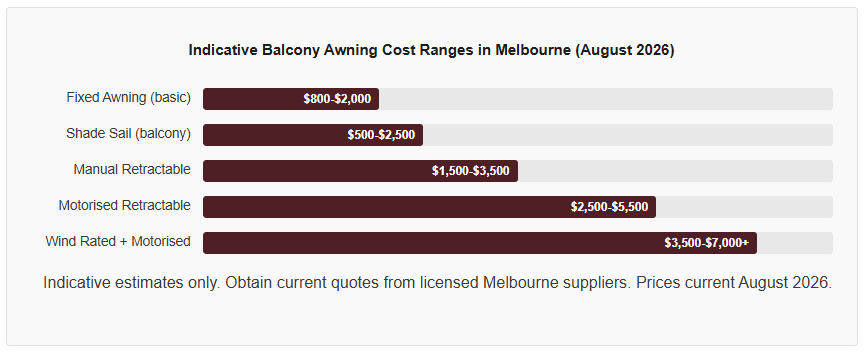
One of the most common questions Melbourne homeowners ask before committing to a balcony awning project is: what will this actually cost? The honest answer is that prices range considerably depending on the awning type, size, fabric quality, motorisation, and wind rating specification. Nevertheless, the following ranges provide a useful starting point for budgeting purposes.
What Affects the Final Cost?
- Awning width and projection: Larger coverage areas require more fabric and stronger mechanisms, increasing cost proportionally.
- Fabric grade: Solution-dyed acrylic fabrics (such as Sunbrella or Recasens) cost more than coated polyester but last significantly longer in Melbourne’s UV conditions.
- Motorisation: Adding a motor adds approximately $400 to $900 to the base price. Wind sensor integration adds a further $200 to $500.
- Wind rating: Higher wind-rated mechanisms use heavier-duty components and carry a higher unit cost.
- Installation complexity: Apartment installations requiring scissor lifts, structural assessments, or heritage-compliant fixings carry additional labour costs.
The Installation Process for Balcony Awnings in Melbourne
Understanding what happens on installation day helps Melbourne homeowners and apartment residents plan accordingly. Professional awning installation is generally clean, efficient, and far less disruptive than most people expect. A standard single-panel retractable awning takes between two and four hours to install on a typical Melbourne balcony.
What a Professional Installation Involves
- Site assessment: The installer checks wall material, structural suitability, and clearance. They confirm fixing points that comply with both the manufacturer’s requirements and any strata specifications.
- Bracket installation: Heavy-duty brackets are fixed to the wall or ceiling using appropriate anchors for the substrate (masonry, concrete, or timber frame).
- Awning mounting: The pre-assembled awning unit is lifted into position and secured to the brackets. For motorised units, wiring is connected at this stage.
- Testing and adjustment: The installer extends and retracts the awning multiple times, adjusting the pitch and tension for optimal performance and water runoff.
- Client handover: Operating instructions, maintenance advice, and warranty documentation are provided. For strata properties, compliance documentation is also supplied.
Additionally, reputable Melbourne installers carry full public liability insurance and provide warranties on both products and workmanship. Always verify this before engaging any contractor.
Red Flag Warning: Be cautious of any Melbourne awning installer who cannot provide proof of public liability insurance, does not offer written warranties, or who avoids providing documentation for your strata submission. Quality professionals welcome transparency at every stage of the process.
Maintenance and Lifespan: Getting the Most from Your Balcony Awning
A quality balcony awning in Melbourne, properly maintained, will deliver between ten and fifteen years of service before the fabric requires replacement. The mechanism itself often outlasts the fabric by many years. Therefore, treating your awning as a long-term asset rather than a set-and-forget installation significantly extends its useful life.
Annual Maintenance Checklist
- Clean fabric with lukewarm water and a soft brush every three to six months to prevent mould and mildew
- Never use harsh detergents or bleach on acrylic awning fabrics as this degrades waterproofing
- Lubricate folding arm joints and pivot points annually with an appropriate silicone-based lubricant
- Check bracket fixings for corrosion or movement, particularly after Melbourne storm seasons
- Test motorised controls and wind sensors at the start of each summer season
- Retract the awning during extended periods of non-use, such as winter months, to protect the fabric
- Inspect fabric for UV degradation, tears, or stitching failure every spring
When to Replace Awning Fabric
Fabric replacement is far more economical than replacing the entire awning. Melbourne suppliers can typically re-fabric an existing mechanism at significantly less than the cost of full replacement. Signs that fabric replacement is due include visible fading, waterproofing failure (water soaking rather than beading off), persistent mildew staining, or structural tears near seams.
Furthermore, re-covering an existing mechanism provides an opportunity to update the fabric colour — a practical consideration when refreshing a balcony’s aesthetic or when a new strata management requests colour standardisation across a building.
Frequently Asked Questions About Balcony Awnings
Yes, awnings are one of the most practical shade solutions available for balconies in Melbourne. For strata or body corporate-managed properties, written consent from the owners corporation is typically required before installation. Always check your building’s by-laws and consult a professional installer.
Awnings require periodic maintenance including fabric cleaning and mechanism checks. Retractable models must be retracted in strong winds to avoid damage. Fixed awnings also reduce natural light during winter. Overall, quality awnings outweigh these minor inconveniences for most Melbourne households.
As of August 2026, retractable awning costs in Melbourne generally range from approximately $1,500 for a compact manual model to $6,000 or more for a motorised, wind-rated system. Size, fabric grade, and installation complexity all affect the final price. Request a current quote as prices vary by supplier and specification.
Alternatives include shade sails, outdoor roller blinds, pergolas with shade cloth, and retractable roof systems. Each option suits different balcony sizes, budgets, and strata requirements. Discuss your specific situation with a Melbourne awning professional to find the best fit.
For most Melbourne balconies, a retractable folding arm awning offers the best combination of sun protection, flexibility, and visual appeal. Compact balconies may benefit from a small fixed awning or vertical outdoor blind instead, depending on the primary concern — sun, heat, or privacy.
Retractable awnings must be retracted during high winds to protect the mechanism. They carry a higher upfront cost than fixed options and require occasional servicing of moving parts. These are manageable trade-offs for most Melbourne homeowners given the year-round usability benefit.
Popular shading options in Melbourne include retractable folding arm awnings, fixed fabric awnings, outdoor roller blinds, Ziptrak screens, and shade sails. The best choice depends on your balcony size, sun orientation, privacy needs, and any strata or council requirements specific to your property.
Pergolas suit larger freestanding outdoor areas and often require planning permits in Melbourne councils. Awnings suit balconies and compact spaces where a lightweight, retractable, or fixed solution is needed. Awnings are generally faster to install, less expensive, and more suitable for apartment settings.
The widespread adoption of air conditioning through the mid-20th century reduced awning use significantly. Today, rising energy costs, increased UV awareness, and the outdoor living revival have driven strong renewed interest. Awnings reduce cooling loads and extend usable outdoor living time, making them highly relevant for Melbourne households in 2026.
Professional awning installation in Melbourne typically takes two to four hours depending on size and type. For strata properties, approved installation methods are required. Always use a licensed installer to ensure structural compliance, proper fixings for the wall substrate, and warranty validity.
Yes. Outdoor living enhancements including quality awnings are widely regarded by Melbourne real estate professionals as adding functional appeal and perceived value. This is particularly true in Melbourne’s apartment market, where usable outdoor space is at a premium and buyers increasingly prioritise liveable balconies.
Melbourne experiences variable and often strong winds, particularly in coastal and inner-city locations. For exposed balconies above ground floor level, a wind-rated awning tested to Australian standards is strongly recommended. Ask your supplier about wind rating classifications appropriate for your building height and suburb.
Yes, strata committees can refuse applications that do not comply with building by-laws or that would alter the uniform appearance of the facade. Providing professional product specifications, colour matching, and engineer’s documentation significantly improves approval success rates. Working with an experienced Melbourne awning supplier simplifies this process considerably.
Quality solution-dyed acrylic fabrics typically last ten to fifteen years in Melbourne conditions. UV exposure, coastal salt air, and cleaning practices all influence longevity. Regular maintenance and correct storage during non-use periods extend fabric life significantly.
Final Thoughts on Balcony Awnings for Melbourne Homes
Balcony awnings in Melbourne represent one of the most practical and cost-effective improvements you can make to your outdoor living space. Whether you are in a freestanding home in Bayside, a terrace in Fitzroy, or an apartment in Docklands, the right awning transforms a weather-exposed balcony into a genuinely liveable outdoor room.
The key decisions are straightforward once you understand the landscape. First, determine whether council or strata approval applies to your property. Second, choose the right awning type for your climate exposure, balcony size, and lifestyle. Third, invest in wind rating and fabric quality appropriate for Melbourne’s conditions. Finally, use a licensed installer who can provide proper documentation and warranties.
Additionally, the energy efficiency and property value benefits of a quality awning installation make the investment highly justifiable over a ten to fifteen-year lifespan. Moreover, with professional help from an experienced Melbourne supplier, the process from initial consultation to installation is smoother than most homeowners expect.
If you are ready to explore your options, the team at Melbourne Awnings has been helping Melbourne residents choose, approve, and install quality awnings for years. Their display centre in Gardenvale lets you see full-scale products before committing — a significant advantage when choosing something as visually impactful as a balcony awning.